Grief: Over Coming and Supporting others

Photo by Pixabay on Pexels.com

I was sitting here trying to figure out the best thing to talk about for this week and I ended up thinking about loss and grief and about how it can be so difficult to overcome, but how necessary it is to overcome.

Over these past few years there have been many instances of grief and loss around the world. While this is true about life any other time, it is especially more prevalent during years when an active pandemic is present. I’m not going to go into talking about the science about the pandemic and what view points people should have or not have, but I am here to talk about something I’m willing to bet everyone experiences during these times of uncertainty, Grief and loss.
Photo by Irina Anastasiu on Pexels.com

So, what is grief?

 On a webpage https://familydoctor.org/grieving-facing-illness-death-and-other-losses/  it is stated that Grief itself is “a person’s normal, healthy response to a loss”. This is indeed true. People need to grieve in order to process all of the complicated emotions and body sensations that happen when they experience a loss. If a person doesn’t properly grieve a loss there are even more negative consequences than what is caused by the grieving process alone.

 Many people know about the five stages of grief, but for the people who don’t know, they are denial, anger, bargaining, depression and acceptance. It should be noted that this is not seen as the current way grief works, at least not for everyone. This model of grief was made in the 60s and it has since been shown that not everyone experiences grief the same way. There is a famous British psychiatrist, Colin Murray Parkes came up with a four stage model of grief based on the work regarding emotional attachment between parents and children done by John Bowlby (very well known Psychologist). The four stages are shock and numbness, yearning and searching, despair and disorganization, and reorganization and recovery. If you want to know more about the 5 stages or four stage models or grief, the very well mind explained it  pretty clearly. You can check their blog out at https://www.verywellmind.com/five-stages-of-grief-4175361
Photo by burak kostak on Pexels.com

One thing not everyone does know is that grief can be triggered by more than the physical death of a loved one. There are many different types of losses while the death of a loved one is a type of loss, there is also things like the ending of a relationship of any sort (romantic, family relationship or friend ship), the loss of a sense of safety and security (such as after a crime, natural disaster, loss of a place to stay or your home, children experiencing divorce,  or security in a relationship such as after a partner’s affair), there is the loss of identity ( such as from loss of a job/demotion at work, loss of the role of spouse, loss of the role of parenthood when children grow up and leave home), the loss of fellowship after leaving a religious or other group or institution, the loss of personal autonomy due to things like from a disability or old age, the loss of a long held dream such as having a baby or what you felt was your dream job, and even the loss of a celebrity that you deeply looked up to or idolized. There are so many different situations that could lead to a person feeling like they’ve experienced a loss that they need to go through the grieving process over, and every single one of those losses is valid and needs to be addressed in a healthy way to prevent very negative consequences.
Photo by Inzmam Khan on Pexels.com

My own grief and losses and how I’m managing them.

I myself, Have experienced a great deal of loss in many different forms throughout my life, even things at the time I didn’t realize were the kinds of losses that could cause grief. I guess you could say I’ve been grieving over one thing or another for my whole life. I know there are many times I have handled my grief in maladaptive ways, and I can’t even tell if I have been grieving a healthy amount or not because of how many things I have had to grieve from. I can say that at this present moment, and due to a different number of events and mental health work I have been doing, I do not currently at the time of writing this feel that I am still grieving any of my past losses and a lot of that healing actually just came at the end of the past year. My life is far from perfect, but for now I feel on top of my positivity and the cycle of grief has not come back for me yet. I find it is easier to trust that someone knows what they are talking about if they provide some information about themselves regarding the topic they are talking about and since everyone deals with loss at some point and since I have delt with it before and am currently in recovery from it, I am going to talk a little bit about the types of losses and grieving I have done, then follow it up with some possible strategies to help you either get to a better place from your own grief, or to help someone else who is grieving.
Photo by cottonbro on Pexels.com

One could say my first experience with grief was when my birth mom left my birth dad with me when I was one, as our family then got broken up and my life changed dramatically, but I don’t remember that time so any affect it had on me is all going on subconsciously and not something I can touch. After that moment my life was full of different hardships. I lost my position as the only child my mom had when I gained an abusive stepfather and two brothers from their relationship. again, I don’t remember most of that just some of the abuse from my stepfather and never feeling completely safe again. The first real instance of grief I can remember is completely losing my sense of safety is at 7 when one of my much older cousins raped me and nothing was done about it, I was told to sweep it under the rug and forced to grieve all alone. Then again when I was 9 and another cousin started abuse over a course of the next several years until I was finally able to get it to stop when I was 15. It took me a long time to realize my early sexual abuse was a real loss because I had pushed it down for so long. It’s so hard to say if my other situations of loss of safety and security were ever truly grieved because from the time I was 2 until I was 15 and a half my whole life was full of physical, sexual, and emotional abuse as well as severe neglect, situations of resource instability and insecurity, constant school, church, and friend changes from moving so much, and loss of my connection to my birth family through foster care, adoption, and setting boundaries with abusive family. Even as an adult I have felt the loss of family and romantic relationships both because of setting boundaries, and because my romantic relationships don’t tend to work out. I have experienced a loss of functioning from disability and a break down, a loss of certain goals and dreams and a loss of physical and mental health with the addition of changes such as mental illness, and type two diabetes with cholesterol issues. I have also experienced the more traditional losses that everyone has which are the losses of loved ones through death.
Photo by Pavel Danilyuk on Pexels.com

When I was 10 I had my first traditional experience of loss from the loss of a loved one when I lost my grandfather. He was my birth mom’s father and one of the only people in my family who never abused or neglected me. We were so close all of the times that we were living close to each other, but he got sick with Leukemia and passed away while I was living several states away after an argument he and my mom had. With him I never got the closure of goodbye, and at the time I didn’t realize he was dead since at the funeral I didn’t see a body, just a cremation urn. I just thought he went away somewhere. It took about two years for the grieving to kick in at which time I started crying hysterically, my mom accused me of not caring about him, and I yelled at her and shoved a bunch of poems I had written about him in her face. From that day when I was 12 and started grieving, not a day has gone by that I haven’t thought of him. It generally gets especially hard on holidays and the month of November when it was both his death and birthdays and the month we had his funeral. Though for the past few years the month has not caused me to have severely extreme reactions.
Photo by Kat Smith on Pexels.com

Many of the other traditional losses were in my adoptive family. They were mostly elderly relatives such as my great great aunt and uncle though one was a teenage boy that was staying with my grandmother, one was my great uncle who died from a preexisting condition at a relatively young age, and one was a friend of my mother’s who had cancer. All of those deaths and funerals I went though did touch me in a way, and I definitely grieved them at their funerals, even though they did not compare to the loss of my grandfather. Last year I had two deaths in my family, one relative who passed from the virus, and one who also touched me in a similar but different way that my grandfather’s death did, that was his wife, my birth mom’s mother.
Photo by Mikhail Nilov on Pexels.com

The death of my grandmother is actually what helped me get relief from my grief. The thing about my grandmother is that she was one of my abusers as a child and so for a long time we weren’t talking at all. She would always talk to my brother who got adopted with me, but she would barely ever talk to me. Then as an adult for years we didn’t talk until I learned that she was sick with cancer and I tried to call her but her throat hurt so she couldn’t talk long. After that I had kept up with how she was doing from the brother I have that lived with her at the time, but did not actually talk to her. Sometime around six months ago, I got a call that she was in the hospital in my town and that she only had weeks to live. At the time I had started doing family history research and had a plan to get closure with her and ask her some questions, but when I got to the hospital it was clear she was in no shape to answer questions, so in that moment I lost my chance for full closure and family history information from her point of view because she would never be fit to answer questions again. I did spend every day for the rest of her life visiting her and with my birth family, even members that I had cut off for safety reasons (but only while she was alive and after her funeral).

That was all tremendously emotional and a great loss, but after her death I decided to start writing a memoir about the ways the lives and deaths of her and my grandfather had affected me I only got half way through before I had to put it down for being too emotional, but It did actually help with my grieving process and added another loss at the same time. I lost the way I had always seen my grandfather when I learned that he was not as perfect as I had come to believe he was. While I still believe he was an amazing person, he had flaws I never knew about as a kid, and once that I didn’t learn about until after doing my family research. This same lose I felt at realizing my grandfather wasn’t perfect, created a path for me to find some type of closure with my grandmother. At the same time I had been putting him on a pedestal, I had been demonizing my grandmother who was usually always angry at me.

The research I was doing for my memoir, helped me realize that she was just a human being who was suffering from some mental health issues and never had the chance to get help for these issues. She also made mistakes that everyone can make and she experienced such intense emotions that even she didn’t understand.  For some reason after I came to a sense of peace with her passing I felt a strong sense of calm, like a big source of tension had been lessened, and I think that was all the grief about everything I have been feeling, because as I think about things now, I have not been feeling the strong effects of grief and loss that I had been feeling before then.

Photo by Tina Nord on Pexels.com Grandma’s favorite bird!

A few months after my grandma’s death there was another loss only this time in my adoptive family. I am not going to talk about that one too much because it is very recent and people in the family are still grieving from it. But what I will say is it was shocking since it was the first personal death I’ve experienced due to covid and I hadn’t seen this person in years. There are others in the family who have been very shaken by these events and I am still trying to be their support system so they may get relief from grief as well.
Photo by Anna Tarazevich on Pexels.com

If you have stuck by me for this long, then thanks for listening and I hope my story has helped show you that you are not alone in your grief and maybe something I’ve said can help you deal with your own grief and feelings of loss. I am now going to take the time to talk to you about possible ways you can heal from a sense of loss and how you may be able to support others going through grief too.

Grief is different for everyone, everyone has different ways that their losses will affect them. For me, my losses made me shut down, my grief lasted too long and it became unhealthy turning into depression. Here are some good ways to help you handle your grief in a way that will make it less likely that your grief will turn unhealthy.

First off you should know that there is no normal amount of time that grief affects us; it could be months or years and it could pop back up at special moments like holidays or milestones like graduations or if you lost someone close to you like a significant other it can be milestones like your child’s first school dance, or birthday or something like that. Even if you heal from your grief, the memory of the loss may continue to be upsetting. All of this is why it is first and foremost important to not judge yourself for grieving longer than “normal” even if it seems that others have moved on. We don’t really know what they are going through in their hearts.

One of the best pieces of advice I can give is to find people to connect with who actually know what it feels like to experience the loss you are feeling and who will be nonjudgmental for the grief you are going through. While everyone either has gone through or will go through the experience of grief, there are many people who don’t know the right way to handle grief, especially in a society where we are taught to stay busy and move on quickly. There are so many people who have never gotten the benefit of fully feeling and healing from their grief. There are many different types of support groups available both around the U.S. at least and online for different types of grief and loss, such as groups for people affected by the suicide of a loved one, the loss of a loved one due to illnesses like cancer and other such groups. There may also be good people you know in your own life who have felt similar things that you may be feeling who will keep you company without burdening you with extra expectations or troubles. Another good idea is to speak with your primary care doctor about the grief you are going through that way they can help you monitor any changes in your habits so you don’t start developing harmful ones which could worsen your health.
Photo by Darrel Und on Pexels.com

The next piece of advice I can give is try to find a balanced routine to get into which includes time for extra rest to help combat the physical and emotional exhaustion that can come with grieving, while also making sure you go to sleep and wake up at the same time every day so you don’t spend all of your time sleeping. If you spend all your time sleeping there is no chance you will recover from your grief and depression is more likely to set in. In regards to balanced routine it will help if you do things like get at least some physical activity which is preferably done outside for maximum affect. Also make sure you are taking care of your self everyday by grooming or dressing yourself even if you are no going anywhere and eat small regular meals even if it doesn’t feel like you are hungry. All of this will help you stay nourished and physically healthy while providing energy to do the difficult work of moving through the grieving process.

During your time grieving all different kinds of emotions are going to come up, maybe even with multiple emotions being felt at the same time. It is important that you don’t try to stuff these emotions down or try to not feel them. Also try not to judge yourself for having any of these emotions and try not to dwell on any of them for too long. Let the emotions come and pass. Using some type of mindfulness practices will be the best at helping you do this. When practicing mindfulness it is easier to regulate your emotions, but during this process it is also important to keep an eye on when you need some professional help too.
Photo by Pixabay on Pexels.com

Try to do things to keep hope alive. Do things like setting small and manageable goals to work on, make a list each day of things you need to get done to help combat the forgetfulness that often comes with bereavement. Don’t make any really major decisions or changes that you have not fully thought out and that you may regret later.

Try to do things that add to your life in a powerful way that helps you keep a sense of meaning and purpose. For some people that’s through things like spiritual practice, for some people its through the service of others, and for other people its through creative outlets like through creating things like music, poems or other written works, even something like journaling or writing a letter to the loved one that my have passed. If you are not grieving a loved one, you can still write a letter. Like if you lost your job you can write a letter of what you wished you could have said to your former boss or coworkers, if you loose a relationship you can write a letter to yourself or that other person in the relationship about all of your feelings and maybe even all of the good things that will come from the end of the relationship. It’s important to note that you don’t have to share these letters with anyone, you don’t even have to keep them; you could tear them up or even burn them, the point is to get your feelings and unsaid words all out so they don’t hurt you anymore.
Photo by cottonbro on Pexels.com

Now is the part where I want to give you advice about how to help a loved one grieve, but the thing is I am in a situation right now where I need to be there for someone who is grieving, but I have absolutely no idea how I can help as this person who passed was one person’s mother and one person’s sister. I’ve never lost either a mother or sister, and there are some very unusual situations involved with this passing. Through doing some research though, I have found a great article from Harvard health. That is actually going to be useful for me and I would encourage you all to check it out here at  https://www.health.harvard.edu/mind-and-mood/ways-to-support-someone-who-is-grieving

New Year! New Goals! New Me?

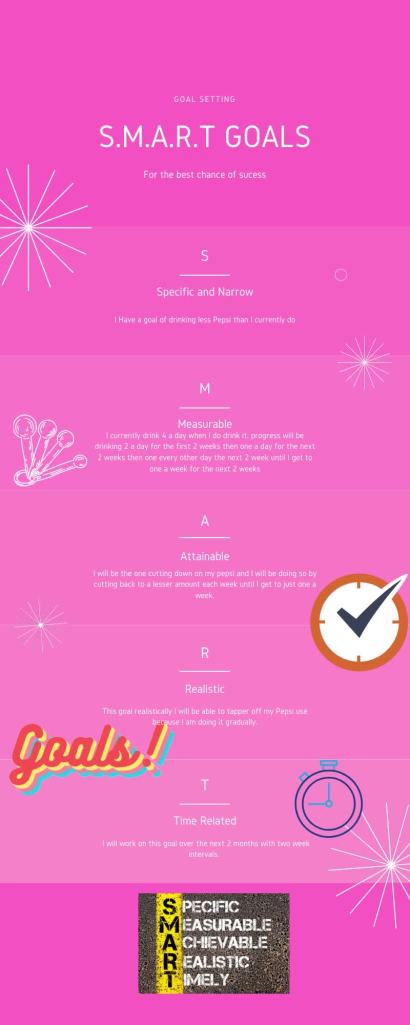
There is an importance to having goals each year even if you don’t call them resolutions. In this new year I have new goals, but I am not a new me so to speak, I am the same me, just with new experiences and goals. Though one could argue that you are a new you each day you live and gain these new experiences and go through these life events, the basics of our personalities stay the same. Though this does not mean we do not learn and grow as people. At the start of each and every new year people all around the world make their resolutions for changes they will make in the new year. Most are about their health changes or changes in their work or education. No matter the change only something like 8 percent of people actually ever acomplish their resolutions by the end of the year. Because of that it may seem like there is no point or that there is no way to ever follow through with your resolutions, but the fact that the number of people who acomplish their yearly goals isn’t zero percent means that there is in fact a way to acomplish those goals. There is also much that can come from making these goals even if you don’t end up keeping them. I have not been successful in keeping my new year resolutions, but I have recently learned a bit of information that, while not new to the world, is a bit new to me. Many say the key to making long term changes is to make sure you are making SMART goals. this is an acronym for Specific Measurable Atainable, Realistic, and Time Related. There are many other blogs which talk about these kinds of goals and explain it much better than I could as of right now, but I have created an infographic with my example of a SMART goal that I have set for my self for this new year which will please my nutritionist, my endocrinologist, my mother, and ultimately my body. I have tried setting this goal multiple times but it was never specific, measurable, attainable, realistic, or time related the way that I had it set up. It was always vaguely worded, like “I’m gonna stop drinking so much pepsi” The problem with making goals like that is there is no clear path of action and no acountablity.

One of the reasons you want to set New Years resolutions is because it creates a sense of hope and optimism since having goals helps give you something to look forward to in the year to come while still not dwelling too much on the past or future. You are setting goals for the future, sure, but you have to do work in the present to achieve those future goals.

Reflections of the past year and what I have learned:

Photo by eberhard grossgasteiger on Pexels.com

Now this past year was pretty uneventful especially when compared with life before the Pandemic started, but there were some both amazing and tragic things that came from the year of 2021 and the year was far better than the previous year was for me.

Photo by Vladislav Murashko on Pexels.com

First off, my grandma passed away in May just days before mine and my mom’s birthdays (I have two mom’s this was my birth mom’s mother and it was before mine (may 11) and my birth mom’s (May 16) birthdays on May 4). Her death came with great sadness as I never got the closure I was looking for, but also with the hope that she is now with either one or both of her husbands (my grandfather her first husband whom she had known since childhood) and her second husband whom was my grandfather’s roomate in the hospital. During this past year, while I had to stop half way through, my grandmother’s death gave me the push I needed to do National Novel Writer’s Month as a rebel who was writing a memoir about how the life and death of my two biological maternal grandparents had affected me. I got a lot done and while it may never make it to shelves as a sellable product it has helped my healing imensely. I may even make a blog post about it some day in the future as soon as I can find a way to make my experiences helpful to the masses.

Photo by Pavel Danilyuk on Pexels.com

The very next month after my grandma’s passing my niece was born from my youngest biological sibling and only biological sister. seeing and holding my new born niece for the first time was amazing, and it has been so wonderful to see her grow even if it has been just throught video chat. Not too long ago I learned that I have a nephew growing in my sister in law’s stomach and while he won’t be here for a few months, learning about him has also been a great joy despite the fact it’s been quite a surprise.

Photo by Ana Morais on Pexels.com

In regards to the virus, it is still going on , but some restrictions in my area have lessened and while they may not stay that way, it has been helpful for morale. Sadly people in my close family had been getting the virus since the middle of last year including my three brothers who are still children my one brother’s fiance and two of my aunts. One relative passed from it. I am not going to start any false information or arguments about the virus and how reliable our current methods of prevention and care are, because I don’t think I’d actually change anyone’s mind either way, and I don’t know enough about the whole issue and the science involved to give any kind of facts. I just know that of the people in my own life that have gotten it, the one who was not vacinated was the one to pass on, though she also had an underlying health condition. Either way no matter what you may or may not believe I reccomend you do whatever is best for you while also ensuring you do your best to protect those who are vulerable and can’t protect themselves. Maybe things like masks and distancing don’t work but if you feel you can’t get the vaccine for whatever health or other reason, and those are the only other options, I feel it would be the best thing to do so you are at least doing something. At the end of the day if it turns out those things don’t actually help, well you haven’t really lost anything by wearing a mask/ shield, or by maintaining distance from those outside of your home.

Photo by Anna Shvets on Pexels.com

Those were the major events for me this year, along with the starting of my bachelor’s program. That has proven to be a challanging adversary. It took me so long to get my associate’s degree as I was dealing with so much health and other challenges, and had to take a break. I started in 2014 and stopped in 2015 not picking it back up until 2020 when the panemic ended up changing how I finished that degree program and didn’t allow me to walk on stage for my degree, but I finished and shortly after started my Bachelor’s degree program just at the middle of last year with 2 rounds of 7 week classes and only about 1 week of a break in between each round with three weeks between last round and the four week class that starts on the 3rd of this month. I am going for social work with the hopes of working in either a hospital or as a licenced clinical social worker and being a mental health counselor. I still have about a year or so left of this program and while it is stressing me out a bit and while, I am having difficulty adjusting with my time managment, I am really enjoying the challange, proving myself, and learning more about the human condition and ways I can help.

Photo by Pixabay on Pexels.com

While I like most of you, spent most of my time at home, I have grown a lot and learned a lot from all of these things that have happened. I have learned how important family is during tragedy and how damaging it can be when family bonds break down. Through all of this I can say my one major goal is to learn not to dwell so much in the past and on the things I can’t control. That is the biggest goal in addition to lessening my Pepsi amount to one a week. I’m not going to be unrealistic and say I know for a fact this year will be the best year ever, or even better than last year, but I am optimistic for the future, and all of the things that I want to get done, all of the different experiences I want to have, and all the people I am going to interact with and grow with both in my family, in my educational path, and in my community. In store for this year is probably more covid shenanigans, more medical and mental health challenges, tests, procedures, and routines, more life events and changes, and more growth and learning. I guarantee that great things will happen, and I also know there is a possibility that some not-so-great things will happen, but I am ready for all of that, because I know I will be able to handle it like I always do, with the help of my support system, and with my own personal strength. The thing is, everyone has their own strengths, and while I cannot guarantee this, I am willing to bet that everyone at least has the ability to develop a solid support system even if they haven’t figured out how to yet. In an earlier blog I talked about the importance of support systems and how to develop one, that may help anyone wondering how to find support if they feel they don’t have it already. I would say that besides personal strength this will be the most important factor in whether or not you accomplish your goals for the new year. It will at least help immensely in addition to setting SMART goals of course!

A Life That Led me to Start this Blog

I have always had one main goal of helping as many people that I possibly can before my time on earth is done. To me that means a lot of things like the career I’m going through college to get to, a licenced clinical social worker which the career I feel I would be the best as with all considerations, though I do have a great tdeal of personal and professional work to go through before I get there. Another way I saw me being able to do this is by my work on this blog and the youtube channel that goes alone with it. The only problem is I haven’t really been posting on here because I haven’t been able to manage my time well enough to do this and school and all of my medical and mental health appointments (plus a lot of deep dives on youtube pointless facebook scrolls when my time could have been spent in other ways). but I’m working on that. for now, as far as this post goes, I want to tell you all a bit about who I am and why you should trust me to talk about mental health and other related topics.

Photo by cottonbro on Pexels.com

I have quite a history of traumatic life situations and mental health difficulties with a wide range of events, health outcomes, and lessons learned. I came from a different family than the one I currently have. My mother was a single parent had mental health and addiction struggles and that had its affects on my life. she did not have the best time choosing relationship partners and I ended up experiencing over 14 years of physical, sexual and emotional abuse as well as severe neglect by all but a couple people in my biological family those were my uncle and my grandfather who passed when I was 10. At 12 I was sent away by my mom to live with my dad who I first met when I was 10 and we were back in my hometown in Connecticut after moving around all over Northern New York. My mom and I had left him when I was one because of issues she had with his mother, my grandmother. he ended up senting me to his sister’s house who sent me back to him and I went back to my mom who had finally sent me back up to New York to live with my aunt who was her sister. I thought things would be better at her ouse but there was a problem. I was still being abused by my older cousinnwho started abusing me when I was 9.

Photo by Lum3n on Pexels.com

Sadly, I couldn’t even escape him when I was taken into foster care at 13 because along with my other two cousins and one sibling who was already at my aunt’s house, him and I were all sent to the same foster home. My aunt had abanoned us to meat someone from online that I had helped her meet. I did feel guilty, but at the same time I felt a bit releived because I though he would for sure stop now that we were in care. He did not thoug and my social worker was the only one who did anything about it The moment I told my caseworker on my cousin I realized the importance of having a social worker who actually cares about you as at the time my aunt had gotten my whole family but my birth mom to stopped talking to me, I was the only one not taken from the foster home as everyone was taken out one by one, and my usually nice foster mother yelled at me because she almost lost her foster parenting license since he was still abusing me in her house.

Photo by Kat Smith on Pexels.com

My social worker did all she could to help me and made sure no one in my birth family abused me again even though she was also my cousin’s case worker. A few years later, I felt the fear of almost aging out of the foster care system with the fear of homeless again. My final foster mom and now adoptive mom said I was welcomed to stay with the family even if I didn’t want to get adopted, but I felt torn still as I felt misplaced guilt about leaving my birth family especially the two siblings who still lived with my birth mom. I ended up staying and getting adopted so my one brother who had no choice about getting adopted wouldn’t be alone without any birth family. In this new family at least for the rest of my childhood (from years 15-18) the abuse stopped, but my problems did not.

Photo by Anna Tarazevich on Pexels.com

There were many situations where I was taken advantage of as a teen by men on the internet, then assaulted more both as a teen and in domestic violence situations with further assaults as an adult. Also once I was finally away from all the abusive people in my birth family, all of my mental health issues like the Complex Post Traumatic Stress Disorder or CPTSD, and depression started. because of the ptsd I started having seudo siezures which is siezure like activity but that doesn’t affect the physical parts of the brain and is just a result of flashbacks. I started having those and fainting spells everywhere like at home and school. I had nightmares and deep depression. at that time it was diagnosed as clinical depression. There was also a time around that age when I was diagnosed with Mutiple personality disorder, even tough I didn’t really have it I do disociate which means it feels like I’m out of my body or my mind goes somewhere else to excape when painful stuff is happening, but I don’t have more than one personality, just one big unique personality. I know what it is like to experience a mental breakdown to have a history of suicide attempts with some being almost fatal and to have self harm urges. I understand the both the necessity of and the struggle to find a reason to stop ever relapsing into another suicidal episode.

Photo by Dids on Pexels.com

 Because of a combination of genetic inheritance, in eutero trauma, and the abuse, I know what it’s like to live life with the mental illnesses of Complex PTSD, Bipolar 2 with hallucinations and paranoia, an eating disorder and high anxiety. I know what its like to go through a system that is quick to diagnose and over medicate and I know what it is like to have competent care providers who are creative and thoughtful and who are able to find other ways to manage trauma than just with medication which I see as being an important aspect when working with actual human beings who may not always benefit from such treatment.  I know what it’s like when it feels like your mental illness is taken over all while even family don’t believe you are suffering. I know what it’s like to hate the word victim because it makes you seem weak, but to also dislike the word survivor at times, because you don’t feel like you’re actually surviving anything.

Photo by RF._.studio on Pexels.com

 I also have a history where I was diagnosed with the developmental disability of autism and to then identify as a person with autism feeling like it all finally makes sense only to then be told recently that I may not actually have autism as it seems that many of my so called symptoms are just from a traumatic past because sadly there is some major overlap in symptoms. I understand living life every day with a chronic and life long physical illness; what it’s like to struggle with treatments and procedures and learning to cope with the fact that you will need these interventions for your whole life. I know what it’s like to live in fear as  you learn that the illness affects every system in your body and how some days I can’t function today isn’t just an excuse but a reality for that day.

Photo by Karolina Grabowska on Pexels.com

On the subject of social diversity, I understand the world from this perspective of a white child and woman with mental physical and possible developmental disabilities both abused and criminally assaulted or victim of domestic violence and with both the points of view as an ethnic minority in her home town but a majority everywhere else she’s lived. I recognize that while I can learn as much as possible about and be open minded to other people from other cultures I will never fully understand it from their perspective, though I believe there are links that connect us all.

Photo by fauxels on Pexels.com

I also have a frame of reference as someone who is not actually heterosexual but still not sure of what label to use and who has been bullied and verbally abused and threatened because she isn’t straight.

Photo by 42 North on Pexels.com

I am also open minded to all religions and know how important religion is in society and for the people who have one. I just think it’s best if we can all accept each other despite these kind of differences and if we can just live our lives without forcing others to share our values as long as the values we have aren’t harming others just by us having them.

Photo by Skitterphoto on Pexels.com

My main values are Compassion, the importance of Community, Fairness, Growth, Honesty, Kindness, Respect, and Trustworthiness as well as open mindedness which was already mentioned as well as creativity in any form, and an appreciation for learning in all ways and in all forms.

Photo by Lisa on Pexels.com

I am a poet and growing writer who still has a lot to learn and who hopes to one day be an author. I do personal and school related research on topics about mental health and social issues which affect people’s day to day lives, and I am always trying to learn more about myself and life in general.

Photo by lilartsy on Pexels.com

I can’t say the bad stuff that has happened to me hasn’t affected me, because it has, but I have also grown a great deal because of it and because of the good resources I have found in my life. I am not completely perfect and I still have problems in life, but I am far from where I started after my adoption at 15 and even from before the pandemic started as that has helped me grow as well. I have been moving out of different comfort zones. and have found key areas I still need to work on (like my energy and will to clean and the will to give up pepsi every day). As we enter into this new year I will be coming back to doing things depression has lead me to give up, like walking and this blog and the youtube channel. And the bottom line and the reason you should trust me, is that I have the knowledge, skills, and experience which all will allow me to hopefully help you, the reader find some calm, peace, and growth in your life too. Though I’m sure you are capable of such things on your own I really do wish to offer any kind of helpful experiences or tips I can and most of all I want you to know that you are not alone and there are people out there who do care about what happens to you and people who can relate to you (not to your exact situation as that is impossible even if the same thing happened to the both of you, but to the emotions you make be feeling and a similar enough experience to what you may have had).

It Takes A Village

Photo by RF._.studio from Pexels

Do you feel that you have a source of support in life? Do you have a solid group of people you know you can count on? You may be wondering why I’m asking, well have you ever heard that old saying “it takes a village to raise a child”? Well, that saying is absolutely true but I’m not a parent, and this isn’t a parenting blog. So why am I mentioning it? Because that saying doesn’t stop being true when you reach adulthood. While you don’t need help being raised anymore, you do need to have a strong stable support system full of different types of positive people in your life who will be there for you in both good times and bad, and that’s what this post is about, the importance of having a positive support systemas well as tips for how to develop one if you don’t have one. We will also take a look at the importance of being a positive support for someone else and how to recognize a toxic support system. Let’s get started!

Photo by Dan Meyers on Unsplash

What is a support system and why does everyone need one?

A support system is a group of different people who you feel you can rely on in any situation whether you’re struggling emotionally, mentally, or with other different life challenges and stresses. Everything need not be a crisis though for you to benefit from having a support system, you can also be supported in your positive moments too. A good support system will rejoice with you during your victories as well as comfort you during your toughest battles.

There are many aspects of life that a positive support system can help you with. As I stated before, they can help you when you are feeling isolated and in the mists of a mental health crisis where you need some solid advice, a positive support system should be able to give you this. There will also be times when you are able to be their for the people in your support system. I know that I can turn to all of the people in my support system for advice, I just have different people I go to for different types of advice, or there are rare times when I will get a second opinion from multiple different people on the same issue.

Photo by Duy Pham on Unsplash

There are times when you will need to stay a bit isolated in order to deal with difficult issues that come up. I know, for example, there are times with my autism where I just feel so drained even spending time with the people I love, not because they are doing anything wrong, but because for me, being on the spectrum means that I am constantly working to determine the intentions and meanings behind everything other people do or say. This gets really exhausting real fast, especially in large groups, and I have an extremely large family. Not only do I have a large extended family, but I have 8 siblings that I am older than and some are still children, who are naturally loud and also teenagery with teenage angst.

That being said, loving and supportive people will notice things about you that you might not notice about yourself. Like, let’s say you didn’t just turn down one or two social functions, but every single one for the last couple of months (or maybe weeks depending on how active your circle is). That’s when there is definitely an issue, or at least perhaps the start of an issue that needs looking into.

Photo by Annie Spratt on Unsplash

Sometimes we can want to do something that we know is bad for us, like texting our ex (STOP TEXTING HIM TRISHA, YOU’RE BETTER WITHOUT HIM). But seriously, we don’t always have our long-term health and happiness in mind, or when in the wrong crowd we may want to do one or all the bad vices. If we surround ourselves with positive, healthy people however, we will be less tempted to do the bad stuff. Like now thanks to someone in my mom’s support system who became part of mine, I’m doing shadow work instead of something dangerous… like heroin or something. (Remind me to do a blog about shadow work when I get deeper into it). The best part about being part of this kind of group is you can be a positive influence for someone else in the group who may be struggling with different temptations.

Photo by Glenn Carstens-Peters on Unsplash

Speaking of temptations, another benefit of a healthy support system is that the people in it can be a source of healthy distraction in your hard times. I should tell you that there is difference between healthy and unhealthy distractions. Healthy distractions are things like a weekend retreat, or learning a skill or hobby together, things that will help reduce your stress levels enough to help give you the strength to tackle your problems head on. An unhealthy distraction is one where you are relying on maybe unhealthy vices like toxic substances which harm your ability to function, or other types of distractions which cause you to want to keep distracting and never solve the problem you are having. My grandpa is always providing me with healthy distractions which usually involve his adorable puppy. He may not realize he is giving me a distraction, but that’s ok, hey maybe I’ll even tell him next time.

Photo by lucas Favre on Unsplash

A positive people in a positive support system will also know when it may be time to convince you to get professional help for your more serious issues that are harder to work through. They will also know how to do it in a way, that you will know they still love and support you, but that they want the best for you and don’t know how to provide that in the most professional and productive way. not because they don’t love you or want the best for you, but seriously, there are some things only a qualified health professional has the ability to do. That’s true for everyone, not just people with physical or mental illness. Like you wouldn’t go to a vet to heal a human. One might think a vet could help some how since they have some type of medical training, but the very best option would be a human doctor with experience fixing humans. The people in your support system may be good for giving you basic advice or personal analogies for how they handled similar situations, but only a certified professional is going to have the exact knowledge and experience to give you the proper help you need

Photo by Mark Williams on Unsplash

Many people hear the term support systems and think it only applies to people with mental illness or who are battling with physical illnesses. While people struggling with these intense issues definitely need a positive people in their lives to support them, they are not the only ones who need to have a group of positive people in their lives. The truth is that everyone has moments where they need positive influences and a source of comfort. This is not just an illness thing; this is a human condition thing. By now you may be asking yourself do I have a support system, if I do how do I tell if it’s a beneficial one or if it is actually doing more harm than good? Well don’t worry, I’m gonna help you by explaining what a toxic support system looks like vs. what a positive healthy support system looks like in the next section.

What is the difference between a positive and negative support system?

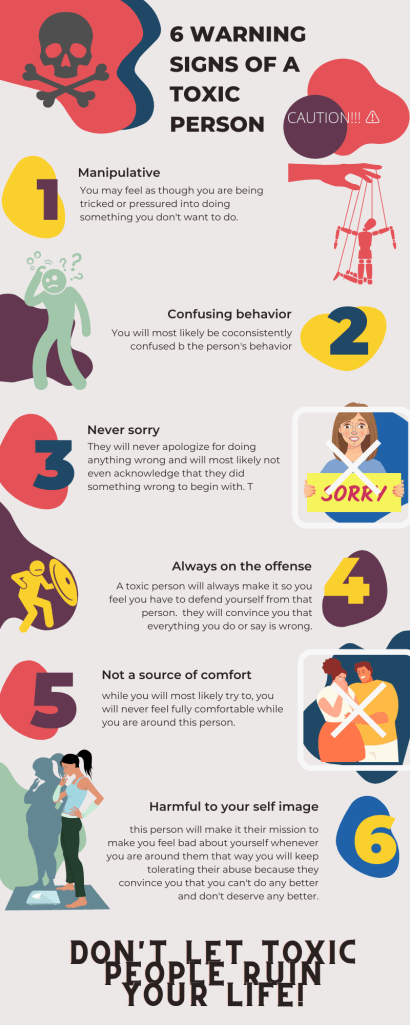
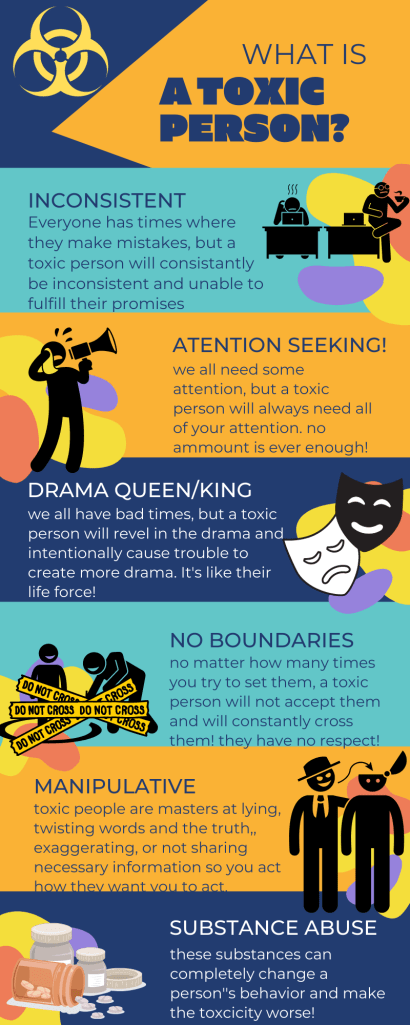
This is a subject that we need to dig a little deeper to get the full scope of everything involved. Before we know what makes a negative support system vs. a positive support system, we first need to know what makes up a healthy person vs what makes up a toxic person.

When I say healthy person vs. toxic person, I’m not trying to say anything bad about people who are sick or ill, and I don’t mean we shouldn’t love or try to support people who are sick, and while toxicity itself isn’t a mental health disorder, the people who are the most toxic are usually dealing with mental illnesses or other types of traumas and stress.

 It would be wonderful if we could magically make our loved ones not toxic and help them find healthy ways to deal with their pain and trauma, but unfortunately there are people in this world who are in need of serious support that only a professional can help them with, or they know they have a problem with their lives or behavior but refuse to get the help they need. Even if they say they want to change, they make no real effort into doing so and instead hurt those around them.

I know this can be a very difficult subject for people and I understand if I sound completely heartless and judgmental, that is not what I am trying to do at all. I have many people I love who are too toxic to be around and who make me a more toxic person when I am around them. I have had to learn the tough lesson of loving them from afar to preserve myself.

 I still keep the lines of communication open for if they ever do come around to the idea of getting help, (Except with the most toxic of people who are actively physically harmful) but I don’t allow them to influence me anymore. There are some people in my life who were once toxic, but who eventually were able to realize they needed help when I did cut my presence out of their lives, so you could even be enabling the toxic person without realizing it and it may be more beneficial for you to cut them out.

Now that you know what a toxic person is, let’s talk about how you can tell you’re in a toxic support system, or how to tell you lack any support.

Well actually the last part is probably pretty easy to realize, you’d know you don’t have any support if you felt there was no one to help you in your time of need or be happy with you in your times of success. But knowing how to tell you have a negative support system can be a bit harder because toxic people have a way of making you feel like you are (pardon my wording here) crazy for even daring to think they are being harmful to you. They are good at being passive aggressive and masking their mistreatment of you in a false kindness.

For example someone who is healthy for you would show genuine care for your health if you started rapidly gaining weight, but a toxic person would make a comment like “You know I wish I could be brave like you to eat whatever I want and not care what I look like” See this is a harmful statement, but the toxic person now has a way to make you feel shame and then guilt if you call them out on the harmful comment by reminding you that they said they thought that you were brave and they wished they could be like you.

When I began to learn this kind of stuff for myself it made it easy for me to see just how many toxic people, I had let trick me into thinking they were part of my support system (there were other types of toxicity too, this was just one example).

Many people who develop toxic support systems don’t realize that their first toxic support system was most likely formed when they were too young to even realize what a support system was, in childhood. Our childhoods, especially our early childhoods shape our entire futures, and many adults are drawn to the types of people they found themselves cared for when they were in those vulnerable stages of their lives.

Photo by Kat J on Unsplash

 Adults who grew up in dysfunctional families are especially more likely to find themselves in the presence of people who abuse and mistreat them in their everyday lives. That’s not to say people who grew up in healthy families will never be in situations where they develop toxic support systems as adults; it just means that they won’t end up unconsciously seeking those people out and they will more likely be able to tell when someone in their lives are being toxic.

Dysfunction in families occurs for a number of different causes and a dysfunctional family is one where multiples of these situations are affecting said family. This is according to the McGraw-Hill Concise Dictionary of Modern Medicine. Some different types of dysfunctional situations for you to be aware of are:

  • Sibling rivalry
  • Parent childhood conflicts
  • Domestic violence
  • Mental illness
  • Single parent household
  • Substance abuse or other addiction
  • Extramarital affairs
  • Unemployment
  • Constant medical problems
  • Other unavoidable life circumstances

Have I got you a bit worried? Don’t worry; these issues alone don’t make the entire family dysfunctional, but the combination of these different types of issues cause serious and damaging effects for everyone in the family. One thing these issues all have in common is they all produce extreme stress which is especially awful when you have multiple issues going on.

 Some of the items on this list like mental illness and addiction also completely change the main person that is affected behaviorally; they may not realize they even have a problem making the effects even harder for them to deal with.

Photo by Myriam Zilles on Unsplash

Because the main caregivers of the family unit can’t effectively protect or care for themselves or their children leading to behavioral changes in their children. For those families where the parents know there is a problem, they may feel great shame and helplessness. A single parent for example may be trying their best to guide and raise their family while working full time, caring for the home, and getting important self-care in too. Because of this they may turn to unhealthy vices or coping mechanisms. Even in families where there are both parents the everyday duties of life may be difficult to deal with while raising children, plus they could have been raised in abusive dysfunctional homes and not know a healthy way to parent their own kids.

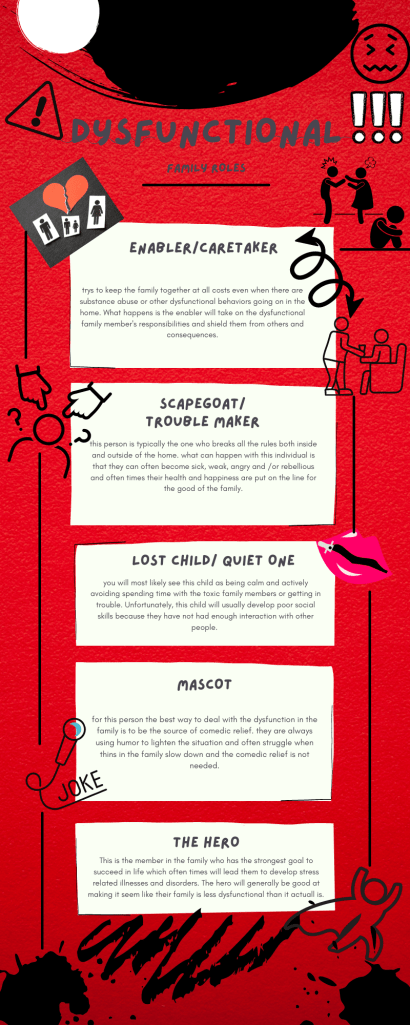
All of these are just some of the examples of ways a dysfunctional family can be formed, and the chaotic environment ends up leading the children stuck in them to develop unhealthy characteristics. There are five dysfunctional family roles that children tend to take on. I think maybe it is possible to develop into more than one of the roles within one child, because as I was going through them, I felt I grew up in multiple ones.

I may have worried you even more with this look at what makes a family dysfunctional. If you are just now realizing that the family you grew up in was dysfunctional, or that you are currently at the head of a dysfunctional family you may feel a sense of shame, shock, or loss. But just because it’s rainy today, doesn’t mean there is never gonna be sunshine. Just like how, just because you grew up in a toxic environment doesn’t mean you can’t develop your own positive healthy system of support. If suspect you have unhealthy behaviors which could be affecting those around you, there are so many places to go for support if you are serious about wanting to change your life, especially now with the whole world at the tips of your fingers. One place I like to go to for advice when I feel I don’t know what to do with my life is my therapist, though I know that is not available for everyone, there are resources like better help and talk space which do virtual counseling for way cheaper than in person counseling (This is not sponsored).

Now that we have talked about harmful family units, I’m gonna share some ways to determine what a healthy family looks like.

Photo by John-Mark Smith on Unsplash
  • Within healthy families there is free and open communication between everyone in the family the communication is also loving and compassionate, but firm when needed.
  • There are no unmet physical or emotional needs for anyone in the family. Even if there is sickness the family is a positive system of uplifting support and encouragement
  • Everyone in the family listens to each other with open minds and appreciation for everyone’s differing opinions and their unique attributes.
  • There isn’t any type of passive aggressive behavior and when problems arise they are handled directly without grudges being held.
  • Each child gets unconditional love regardless of their behavior. They are disciplined in a safe and healthy way, but the love stays no matter what. Also no one child is favored over the others, nor is one used as the scapegoat where all the family problems get blamed on that child
  • Everyone in the family works as a team to achieve mutual goals.
  • Each family member is free to develop their own personalities, preferences, interests and opinions even if someone in the family doesn’t agree. No parent is living their lives through their child.

Our first support system can really set the tone for how our entire lives play out, and how we develop our own adult systems of support; if we grew up in a positive loving home we are more likely to know our self-worth and go where we are valued and loved even when we may be in the wrong and need some guidance. We are also going to have an easier time finding these people who will be their for us in our darkest storms or our proudest moments. When we come from a negative and toxic childhood we are more likely to gravitate towards people who don’t have our best interests at heart, sucking our energy with their over-dramatic or consistently gloomy outlook, or even people who are intentionally manipulating us and causing us harm in order to make themselves feel better.

Photo by Nicholas Bui on Unsplash

I have a lot of unique experience with both toxic and healthy support systems. As I’m sure many of you felt for yourselves, I grew up in what can be considered a dysfunctional family and toxic support system.

In my birth family my parents were separated since I was a baby and one was an addict, severely mentally ill, and first nonexistent, then verbally abusive and sexually on one occasion. This parent may have tried to do the best they could, but their best was so harmful, it is still unsafe to allow them access to my life, and I am now 27 years old. I wish that person to get healthier and realize their toxcisity but unfortunately I don’t think that will ever happen as they are still unchanged even now that they are addiction free and refusing to take their mental health medication.

The other parent started off doing the best they could while dealing with their own mental health and addiction issues. It should also be mentioned that they were both pretty young when they became parents. The parent who changed their ways also spent much of their time as a single parent and one who was emotionally hurting for reasons, they didn’t understand leading them to be drawn towards abusive partners who also physically abused that person’s children. That plus other life factors like unemployment and poverty made it nearly impossible to function in a healthy enough way to raise four children on their own.

 I hold no ill will towards this person, but the fact of the matter is, all of these factors with both parents made my first living situations very toxic and dysfunctional. Things also got harder as I was ripped away from both parents as a pre-teen and sent to live in kinship foster care (Where you are not with your parents but still with biological family). Just as I was getting a bit comfortable with that (It was still very toxic and dysfunctional as I was still being sexually abused and there was addiction and domestic violence) three of my cousins, one sibling who was with me, and I were sent to live in full foster care with people who were not related to us and whom we did not know. This living environment was better, but still not ideal as there were still serious dysfunctional elements and we were eventually all separated until it was just me and my one sibling at the home, we would later get adopted in.

Photo by Annie Marek-Barta on Unsplash

Why did I share that story, well to share with you how I know what I’m talking about when I say dysfunctional families can affect how we develop and how we even understand what a positive support system looks like? I was constantly abused, mistreated, and shuffled around from harmful family units all while being at crucial development stages in my life.

Because of this, I started to display toxic behaviors that I really had to work through. I ended up being like the enabler, the lost child, the mascot, and the hero all in one. That’s four of the five roles’ children in dysfunctional families take on. Besides that, my early life has deeply impacted my life as an adult. I often still question if I am worthy of a positive support system and if I am a positive support for other people, or if I have too many issues affecting my adult life to be consistently positive and optimistic. (Luckily as I was doing research for this, my adoptive mom let me know she doesn’t see me as being toxic, so it really helped me out, she’s not one to lie about that, not even to her children).

As an adult there are some things, I am extremely grateful for. I am grateful I am still alive despite all the odds. I am also grateful that I have been able to grow and develop enough realize when I am around someone who is harmful to me. One thing I need to be better at is telling the toxic person that I can no longer have them in my support system until they are willing to put in the work to heal their own traumas and find healthy ways to relieve their stress. I was able to do it with both of my biological parents which was huge, but I still constantly feel guilty when I stand up for myself and I never want to make anyone mad at me. The thing is, because of the support system I have developed now, I now have enough people around me to stand with me when one person in my system ends up displaying toxic behavior. I just recently had to let go of a few people who I never dreamed I’d have to say goodbye to. The door is still open, but it’s the screen door… and its locked.

Well now you know why you need a support system looks like, what toxic people and toxic support systems look like, what a healthy family and support system looks like, and a little bit of my personal experience with the whole subject, but what I haven’t told you yet, is how to form a support system. Let me get to that right now!

There is literally potential for members of a support system everywhere! At the park, at they gym, different events and functions people regularly find themselves attending.

Just think of how easy it is for kids to make friends. I’ve seen kids’ bond over the characters on their shirts and backpacks. Sure those friendships don’t always make it to adulthood, but for those children, those friendships are part of their support systems even if just for a while. Here are some examples of places you can turn to if you are feeling you really lack a meaningful and well balanced, positive support system.

Ok, so let’s say you already feel like you have the strongest support system you could possibly have, and you feel there is nothing else you can do to make it any better. After reading this post, or maybe you were already wondering, you may be wondering how you can ensure your relationships stay healthy. This is an important part in being supported in your time of need, nurturing your relationships. As I have already said, we all need support and comfort sometimes.

 Even if you feel the people in your support system are strong are the strongest people in the world, there will be times where they will need to lean on you, or times where no one is leaning on anyone. In these times though, you are still gonna want to spend time with the people who make you feel so good, you are still gonna want them to know they are loved and valued (that is if you are not a toxic person yourself). This is why continuing to strengthen your bonds and care for each other with mutual give and take is going to be essential for the rest of your lives. There are all kinds of ways we can foster happy and healthy relationships with the people who are already in our support network.

So now you know all about support systems, how to tell the good from the bad, ways to develop a support system, why it’s important to have one and be supportive to others, and ways that you can keep your current supportive relationships healthy ones. You now know everything, or at least everything that I can currently teach you with my current level of experience, knowledge and understanding. So don’t be afraid, get out there and form your own supportive network, or spend some time with the people in your current one. And if you are starting to suspect you may be one of the toxic people in someone’s system, well it’s not to late to seek professional help or to take baby steps to begin the process of healing. If you feel there are people in your own system who are causing you more harm than good, sit down and have an honest chat with them about it. They may not even know they are doing anything wrong, and if they do know but are unwilling to change, don’t be afraid to let them know there can’t be a place for them in your supportive circle until they come to a point where they are ready to heal.

Why Just Medicate When You Could Also Meditate: The Power of Meditation on the Mind-Body Connection.

Disclaimer, this article is not to be substituted for professional individual physical or mental health diagnoses, treatments, or any other type of medical advice. This is just a guide of information I have collected about the practices of meditation and what it has the potential to do for those who try it. I also acknowledge that it may not work for all and that in some situations it may end up being harmful. please contact your doctor if you have been meditating but feel any adverse side effects and discontinue your practice until otherwise advised by your doctor.

What is meditation, and why should you start doing it right now?!

Got stress? Anxiety? Unhappiness? Well, what if I told you there is a way you can relive some of those negative feelings in a healthy way that has been shown to get results for a majority of the people who stick to it, would you at least try it? I am here to tell you about something you can do right now absolutely for free with a smaller number of risks than there are benefits to meditation. This has been practiced for centuries over in the eastern civilizations and started out as a way to find deep spiritual connections. Now it is used all over the east and west still for its main purpose, but also as a way to find happiness, peace, and to relieve stress. Incorporating meditation into your daily practice can benefit you greatly especially if you stick with it even when you feel like you don’t want to, or that you just don’t have the time (there are so many meditations available even ones that are just up to 5 minutes, plus you can meditate anywhere so long as it is quiet). That being said there are potential risks that can come up while meditating, especially for people who are new to the practice, we are gonna talk about what those are so that you have as much information as possible before you start out.

What is meditation?

History of meditation

Ok, so before we get into detail about the benefits and risks of meditation, or why to do it in the first place, we need to first know what it is and it’s nice to know how it started. According to Psychology Today, there are archaeologists who place meditation as being practiced as early as 5,000 BCE. The practice also doesn’t seem to be attributed to just one religion. It has been found that meditation is a practice that was and is used in Egypt, China, within different religions like Judaism, Sikhism, Hinduism, Jainism, and the one everyone seems to know about which is Buddhism. You may be asking how did it spread to so many different places and who started it first, unfortunately, there is no agreement as to who started using meditation first, but researchers have found that it started spreading worldwide around the fifth or sixth centuries BCE throughout the Silk Road where the trade of goods and culture was common. Each new culture it would reach would adapt it to fit their styles and needs. Despite how popular the practice was becoming in the east it would be a really long time before it became more than just a religious practice, especially in the western civilization; that wouldn’t end up happening until the 20th century (I’d just like to point out we are already on the 21st century so definitely not that long ago).

What it means today

In this modern world, meditation is used mostly as a mind-body mindfulness practice that can be used alongside modern medicine. There have been many people who have meditated who were able to reach a deep state of tranquility and calming relaxation. The goal is to get rid of stress by clearing your mind of all the thoughts and feelings that cause you to get stressed out which can help you both physically and emotionally. It can still be used for spiritual and religious reasons as a way to connect with your higher power for some people, and a way to connect with the complex universe around us. Some people feel they go into a higher plane of existence when they meditate. This often leaves people feeling spiritually stronger, rejuvenated, and more positive throughout their day.

Photo by cottonbro from Pexels

Different types of meditation

  • Guided meditation. For this meditation, there is a narrator or speaker who is inviting you to imagine or visualize a specific scene or even something like a colorful light surrounding you. This type of meditation is relaxing as the voice is usually gentle and soothing, and the processes the voice takes you through are usually calm and peaceful. You will usually be asked to focus on your breathing and to keep bringing your thoughts to the scene or present moment if you start to drift into other thoughts. This is the type of meditation I use the most and it often involves as many of the 5 senses as possible to activate your whole body.
  • Mantra meditation. This style of meditation involves the one doing the meditation to calmly and silently chant or repeat a word, thought, or phrase as a way to prevent them from getting distracting thoughts. The goal of this one is to stay 100 percent in the present moment to completely clear your mind. In this one there is no guide or imagery just the repetition of the calming word or phrase you have chosen. I have never actually tried this style of meditation, though I can see how it would be beneficial.
  • Mindfulness meditation. Mindfulness meditation is the one that everyone seems to be gravitating towards and is the one people traditionally think about when they hear the word. The main goal of this style is to stay completely aware of what is going on in the current moment and fully accepting it as it is. This is one style of meditation where the biggest focus is on the breath and the absence of thought. While doing this type of meditation different thoughts and emotions may come up, the key is not to hold onto them, but rather let them pass without placing judgment. I do practice this kind of meditation but usually, at the same time, I am doing a guided meditation.
  • Qi gong. Qi Gong is a style of meditation that started in China and has stayed a form of Chinese traditional medicine all this time. This practice is a combination of multiple different components; it incorporates meditation, relaxation, physical movement, as well as breathing exercises as a way to regain and keep balance. This is probably not a type of meditation just anyone can do without special training or support from a traditional master of the practice, just like the next type of meditation Tai Chi.
  • Tai chi. Tai chi isn’t a typical form of meditation and it again requires the help of a trained mentor in order to get the benefits from it. It is a style that requires dedication and discipline which is best given by a trained professional. It is a type of martial arts, but it is a very gentle and mild form that is not used in any violent way. It is self-paced and involves a series of different postures that are done slowly and gracefully as the person doing them practices deep breathing. I would be very interested in trying out this form of meditation but have not had the chance to at this time.
  • Transcendental Meditation® This form of meditation is similar to Mantra meditation. Once again you will be silently repeating a mantra to yourself such as a word, sound, pr phrase, but it will be done in a specific way. With this type of meditation, the goal is for your body to reach a state of deep rest and relaxation. Your mind may reach a state of peace without requiring any type of effort or concentration. This is another form of meditation I have never actually practiced before.
  • Yoga. Yoga is a type of meditation you will most likely already know about, but you may not know it is seen as a type of meditation (I know I was surprised). With this type, as I’m sure you already know, the practicing individual carries out a number of different motions and postures as a type of physical exercise that also has mental health benefits. By doing these poses you will gain more flexibility and a calm mind. The main goal with this type is that you will focus more on the present moment and less on what is to come or what has already happened. This is a very accessible form of meditation as there are multiple YouTube videos and classes you can go through just like there are multiple guided meditations available on YouTube. Yoga is another form of meditation I have practiced over the years, and I personally always get a lot of benefits out of it, I just have the problem of overextending myself one day and not wanting to keep going the following days. I definitely need more regular meditation practices.

Why should I meditate?

Many people who have tried regular meditation have found it to provide a wide variety of physical and mental health benefits. While not all are able to experience the positive effects, and some may have negative side effects from meditating, there are those, myself included, who believe it has a calming stress-relieving effect. On top of that, you may experience one, or all of the following emotional health benefits.
  • Gaining a new perspective on stressful situations
  • Building skills to manage your stress
  • Increasing self-awareness
  • Focusing on the present
  • Reducing negative emotion
  • Increasing imagination and creativity
  • Increasing patience and tolerance

As far as physical health goes, there is a smaller but still growing group of researchers who are realizing there may even be many physical health benefits that go along with meditation. There are some researchers who feel it is too soon to make explicit claims that it absolutely heals or even helps with physical ailments. Both of these points of views should be taken into account before you begin your own meditative journey. Some of the possible physical health benefits are that it may help manage symptoms of a great number of physical illnesses like.

  • Anxiety
  • Asthma
  • Cancer
  • Chronic pain
  • Depression
  • Heart disease
  • High blood pressure
  • Irritable bowel syndrome
  • Sleep problems
  • Tension headaches

It should be stated that no matter what reason you do meditation it should not be used as a replacement for modern medicine, but rather it should be used in addition to treatment from qualified physical health or mental health treatment providers. Before you start any kind of meditation you should also talk to your trusted health care provider especially since it can have negative effects and can worsen some mental health conditions.

What are the risks of meditation?

Are there risks? Well unfortunately as with anything people use or do, yes there are potential risks that come along with meditating that first-timers should be aware of before they start that way they are fully aware of everything that could happen. I would just like to say that it does seem the benefits are more commonly reached than the negative side effects. It also seems that most people who don’t feel the benefits are just most likely to not feel any change rather than to feel the bad side of things. Just because it isn’t as common for someone to have harmful side effects, doesn’t mean it is not a possible issue, nor does it mean that it should not be talked about. So here are some of the negative experiences that have been felt while meditating.

  • Increase in negative thoughts
  • Delusions or paranormal thinking
  • Negative changes in executive function
  • Changes in the way you see, smell, hear, and taste, a phenomenon that may present in hallucinations.
  • Possible frustration if you try to meditate to get hallucinations, but are unable to
  • Decrease in motivation and lack of interest in previous activities similar to depression
  • Reliving negative emotions or memories. This can happen when the meditation brings up these thoughts and you are unable to let them pass (totally not your fault) what comes up with this can be fear, paranoia, anxiety, depression, and grief.
  • This can include physical health symptoms just like how it can cause positive physical health symptoms: pain, pressure, involuntary movements, headaches, fatigue, weakness, gastrointestinal problems, and dizziness.
  • You can also end up losing your sense of self people have noted a loss of agency, a loss of basic self, and a loss of ownership. Some also noted a blurring between themselves and the outside world. This loss of self is actually something many Buddhist meditators, for example, hope to achieve, though for some it can be really difficult to deal with.

When you take a minute to look at it, that does seem to be a lot of possible side effects, and it definitely is. That is why it is very important to seek professional advice before starting your journey. Don’t just go by what is popular, or what a friend says as each person’s meditation journey is unique and specific to them even if they all practice the same way. Next, I think it’s only right that we talk about ways to get the most out of your meditative practice should you decide to start.

How to get the most out of your meditative practice.

There are some common different aspects to meditation that you can expect to use should you begin your meditation practice.

  • Focused attention. This is one of the most important parts. When you focus your attention on something in the present like your breathing, your mantra, or your guided visualization you are easier able to let other thoughts and emotions pass by without lingering and you are more likely to prevent yourself from having any negative thoughts or emotions from affecting you.
  • Relaxed breathing. This is another major component of the positive effects of meditation. It may be shocking to hear, but there is a good chance you have been breathing wrong your whole life, especially at times you feel you are stressed or in a crisis. Typically, we tend to breathe more rapidly and shallowly especially during these times of stress. During meditation, if you have a guide helping you, you may very often hear them talk about your breathing, staying focused on the breath, and being told to take slow deep breaths. You will be told to inhale then exhale (just make sure you keep doing that even if they start talking more about the imagery right after they say inhale because I often struggle with holding my breath for too long). When you breathe deeply like this you are using the muscle called your diaphragm which is a very thin muscle under your lungs that holds everything in place. By doing these slow deep breaths you are taking in more oxygen and reducing the use of the shoulder muscles, neck muscles, and upper chest muscles which leads you to breath with more efficiency This technique involves deep, even-paced breathing using the diaphragm muscle to expand your lungs.
  • A quiet place to practice. This is more of a must-have when you are still new to meditating and until you are able to grow stronger in your practice with your discipline and focus. You will also find it much easier to get into that altered state of consciousness. By quiet place, I mean with as few distractions as possible which includes all electronic devices other than for the use of playing your meditation music or guided meditations with. The more you practice, however, the more likely you will be able to meditate no matter where you are and no matter how long you have even if you are at a stressful event like a meeting, long line, or stuck in traffic.
  • A comfortable position. There are no exact rules as to how to meditate, where to meditate, or in what position. For example, you can meditate while sitting, walking, lying down, or while doing different activities. There are actually a bunch of different ways you can meditate in your everyday life, and you probably even do some of these activities already. No matter what you are doing though, you are gonna want to stay as comfortable as possible so you can stay in the moment. Good posture is also important during your meditation it will help keep you supported and will help you stay more relaxed.
  • Open attitude. With many other mental wellnesses and or spiritual activities you have to stay as open-minded as you can in order to see many of the results. If you are closed off or believe it’s not going to work it will most likely end up becoming a self-fulfilling prophecy where you will end up acting in a way that will cause you to not see any results. Don’t go in with too many expectations especially not as you first start because sometimes it takes a while of practicing to get into those states of altered consciousness. Despite this, you are still going to want to put as much positive energy you can into your practice. If you believe in the power of manifestation as some including myself do, you believe that the universe brings us what we mentally tell it to, meaning if you believe you are going to have a good meditation experience you will be more likely to get benefits out of meditation.

What are some ways I can meditate?

  • Deep Breathing. As we talked about before, this involves slow deep breathing using the diaphragm and staying concentrated on the breath. What I forgot to mention earlier was that when you practice your breathing you inhale through your nose, and exhale through your mouth. If you feel yourself start to wander from thinking about the breathing, don’t worry or feel bad, just try to quickly catch yourself and refocus on the breathing. This is a really good technique you can use no matter where you are or what you are doing since breathing is something everyone needs to do.
  • Body Scans. This is another one that you can do no matter where you are or what you are doing. For this exercise, you are going to spend some time focusing on different parts of your body from the tip of your head all the way to your tiptoes (or from your toes to your head). While you are going through each part of the body start to recognize all of the sensations going on in each area. A part may hurt notice what type of pain and how severe. A part may feel very tense especially if you are particularly stressed and hold your stress in that area. You may even feel warmth and relaxation in some parts take notice of that too. Throughout the whole process mix the deep breathing from the first way to meditate and add in the imagery of you breathing in relaxation or heat to a part of your body then exhaling negative feelings.
  • Repeat a mantra. This is a type of meditation we talked about earlier, but I feel like I should let you in on a little secret. Mantras can be anything, they can already exist or you can make them up, they can be religious or spiritual for any religion or practice, or they can be secular and not tied down to any type of faith. Some examples of religious ones are the Lord’s prayer which comes from Christianity. The Holy Name of God which can be found in Judaism, or the one pretty much everyone who has heard of meditation associates with the practice, the om mantra which is used in Hinduism Buddhism, and many of the other eastern religions.
  • Walking while meditating. Meditation while walking can be a bit strange especially since there are likely to be more distractions, but people get into a trance-like zone when they are driving to places, they have driven too many times before, and they end up perfectly safe. Just try to be aware of all of your surroundings as well. During this activity, you are going to slow down your walking pace so you will be able to concentrate on the individual movements of your legs and feet. The goal is not to focus on a specific destination, but rather on the movements you are taking. You can do this whenever and wherever you are walking to (I like to walk in the little nature reserve areas in my area like the one right across the street from my apartment complex). While walking and focusing you are going to keep repeating action words in your mind like the words moving, lifting, placing while you are lifting each one of your feet, moving each of your legs in front of you, and setting your foot down in preparation of the next step.
  • Praying (no matter what religion or spirituality). Prayer is practiced all over the world in all different religions by millions of people every moment of every day. It may be surprising to you, or anyone else, but prayer is a meditative activity. There are written and spoken prayers in many different religions. On top of that you can pray with prayers you come up with, or by using ones that have already been created. There are many different places you can go to in order to find already made prayers like your favorite search engine (mine is Google), your personal spiritual leader at whatever religious or spiritual organization you go to, you can even look in the religious section of your favorite book store.
  • Read and reflect. One thing that can be helpful for many people is to read and determine the meaning of inspirational or other types of emotionally or spiritually charged text like poems, the Holy Bible, or other types of sacred texts. Many people report that they benefit from reading poems or sacred texts and taking a few moments to quietly reflect on their meaning. You can also get these benefits from listening to any type of sacred, inspiring, or other relaxing music. It may even be helpful to keep a journal detailing your reflections, thoughts, or feelings about the material and what you believe it to mean. You can also go over the results with a trusted friend or spiritual leader.
  • Focus your love and gratitude. For this style of meditation, you are going to concentrate all of your attention on a sacred being or images these can either be in-person representations or visualize images that represent your sacred being or image. when you are doing the visualization, bring in feelings and thoughts of gratefulness, love, and compassion. This is something I definitely need to do more of, but first I need to find out what I find sacred.

Final thoughts

So now you know a bit more about meditation. It has been around for literally millennia as a form of spiritual practice, then found its way along the silk road and eventually all over the world still being used for spiritual purposes but having the added benefit of enhancing your mental health and possibly your physical health as well.

There are numerous mental health benefits like relieving stress and calming the mind, and there have been new research studies coming out that say it may benefit your physical health as well by relieving some of the symptoms of many different physical ailments. That honestly makes sense as our minds and bodies are so closely connected. If you are physically ill you don’t usually feel so great mentally, and our mental illnesses have been known to have physical manifestations such as stomach issues, and tension in the areas where we hold our stress (that’s why a massage can feel so painfully good).
While there can be many different benefits to meditation, there can also be some unintended side effects that can be pretty damaging. It is for this reason you should get advice from your personal licensed medical or mental health professional (or both). It is also why you should not use meditation as a replacement for true physical or mental health treatment but in addition to traditional modern medicine. You also should not be doing it just to have certain negative effects like hallucinations as it is less likely to happen if you want it to, and will just end in frustration when it doesn’t end up happening.

There are several things you can do to make the most out of your meditative practice such as journaling about your experience, meditating in a quiet environment free of distraction, and keeping an open mind. It can seem like a challenge to find time in your busy schedule to meditate, but there are many different ways to do so, and there are ways to meditate no matter where you are or what you are doing.
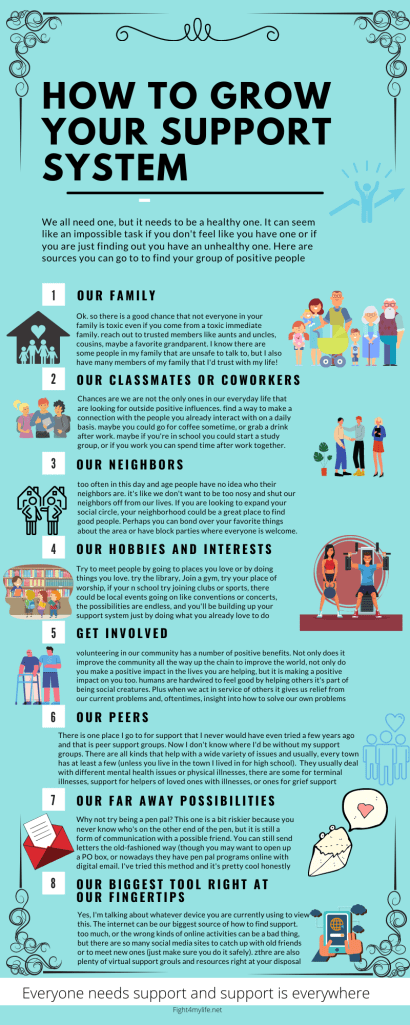
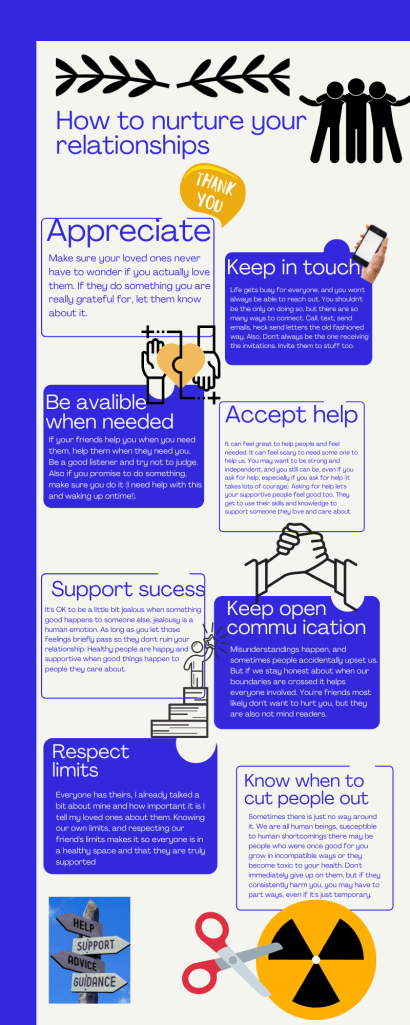
One common way people meditate is through prayer which is used in many different religions and spiritual practices. Some other quick ways to mediate are through body scans, mediating while you are walking, breathing exercises, and by chanting mantras to get yourself into a state of peace.

No matter why you do it, where you do it when you do it, or how you do it, meditation is a centuries-old practice that can be a restorative and stress-relieving activity to add to your everyday routine and you can do it right now for absolutely free. You don’t need any special materials or equipment, only what you absolutely want to have and what you think will help get you into a peaceful state. So I urge you right now that you are done reading this to at least make a plan and set of goals and objectives to start meditating as soon as possible.